
Chestnut Street
Doc Hanson

Chestnut Street
When I was about 14 I fell in love with my wife who wasn’t my wife yet when she and her sister, along with their mom, walked past the open door of Ms. Swanson’s English class as we all sat reading Huck Finn, praying our zits wouldn’t pop during class. There was something so entirely arresting about her—the way she moved, the way she wore her clothes, the shape of her body beneath them. It had to have been mere seconds—I probably saw her take three steps before she was out of my view and down the hallway toward the principal’s office to formally register for school. It was early October, and she, her sister and their mom had just arrived in town after her mother and the person she called her dad divorced.
The next day when I learned she’d be in Ms. Swanson’s English class the same hour as me, I was elated but nervous. Since my last name started with T and hers started with D, the alphabetically arranged classroom had me in one of the last seats in the last row in the room, against the window, right behind Rhonda Rubish. With her D name she’d be in the first row, next to the door and hallway. This would not do.
One of the kids in that first row was Mike Decker. From my calculation, my future wife would be seated just ahead of him. As such, I properly threatened Mr. Decker to switch seats with me and quickly made up something for Ms. Swanson about needing to sit closer to the front of the room so I could see and hear and stay more thoroughly engaged in class. I’m not sure she bought it, but she acquiesced and, Boom! It was on.
And then off.
Within the week I’d stupidly introduced her to one of my best friends and they became a Happy Couple for the rest of high school. Even so, my extremely intense interest in her never waned, despite my sincere efforts to ignore it. Like trying to ignore the sky.
We remained close friends in that impossible-for-guys way that Larry David talks about and eventually we went our separate ways for a couple of college years before reuniting forever in 1988.
But before all that, there were summers where the rules of relationship that were in play during the school year got mushier and I found myself in her presence, usually along with a gaggle of her friends, often with her boyfriend around, which was annoying for all three of us. During one such night after sneaking into the Pinehurst Park swimming pool, a bunch of us were invited back to Michelle’s house to do whatever 14 year-olds did in 1978, which I think was mostly raiding the refrigerator, maybe casting around for some stray booze that no one would miss and, now and then, a quasi-innocent make-out sesh or two. It was mostly just about sharing space with like-minded, like-bodied adolescents and learning about yourself by finding out about everyone else.
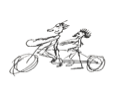
The house Michelle lived in was up the hill from the swimming pool and in some incredible twist of fate, I ended up giving my not yet wife a ride there on the back of my ten-speed.
On the corner at the beginning of the hill was situated a large, three-story, impressive-looking, colonial with Grecian pillars on the front, classic white clapboard siding and tidy black shutters, lined with sharply appointed evergreen trees and a white, picked fence.
Doc Hanson’s House. This was the rich part of town where the paper and textile mill executives lived, beginning in the early 1900’s. By the time I was huffing and puffing my Huffy up the hill with my not-yet-wife, the neighborhood was still decidedly upscale, particularly compared to my neighborhood in the center of town, full of ramblers and ranch-style housing stock, built up beginning after the 1918 fires and then again in the early 1960’s when all of us Baby Boomers were forcing our parents to hurry up and build neighborhoods.
While the newest “rich neighborhoods” were the Antus Addition south of town, which turned out to be just “new” and not “rich” housing for mostly teachers and cops, and the nascent stirrings of development in Erickson Acres, where the earliest Yuppie-Boomers staked their claim, this neighborhood—the Pinehurst Park area, represented Old Money, relative conservatism and everything else my parents weren’t. This was the best Trick-Or-Treating in town. It was a part of town I rarely frequented as a kid and, as I cranked up the hill, amorous adrenaline pumping as fast as the lactic acid in my quads, I felt somehow adventurous—as if exploring my town for the first time on my own terms—and it was exhilarating.
“I’m going to live in that house someday,” is what I heard from behind me as I lurched the two of us up the hill.
My heart sank a little. In my head I thought: I’ll never make enough money to live in a house like that.
……….
And then it was 1996. Eight years earlier, I’d somehow managed to convince the girl on the back of my 10-Speed to marry me after all. We had four amazing children and my supernatural wife had somehow manifested the intention she’d voiced from the seat of my ten-speed as I’d pedaled up the hill 18 years prior, past the house in which we now lived—and would occupy for the next 20 years.
Doc Hanson’s house.
Doc Hanson had been a fixture in Cloquet, raising his family—two daughters—along with his wife, while working his medical practice at the Raiter Clinic. Longtime neighborhood residents and nearly everyone I told where we lived had colorful stories about the good doctor—how he’d be seen every winter roped to the chimney, clamoring over the rooftop, plugging in reindeer decorations for Christmas or removing snow. Other stories of him smoking cigarettes as he examined patients was a reminder of how long the doctor had been a part of the community and living in the house I now inhabited.
In the twenty years I lived there, I was never quite able to fully exorcise the Doc Hanson imprint on the place. He’d done an excellent job at branding it.
As time went by, the house became Home. We raised our kids in it. We fought in it. We loved in it. We screamed and shouted tears of joy and pain in it. We salved our wounds in it and planned our lives and lived out the myriad dramas that are inherent to family life—all beneath the roof Doc Hanson had so dutifully pushed snow off for decades. My own boot soles would never grace that rooftop.
The interior, though, yeah, we worked our asses off on the interior. By the time we moved into the place, it had been abused by renters for several years, Doc Hanson having given up the place for a resting spot next to his wife in the cemetery across the street.
We stripped the walls of 8 layers of decades-old wallpaper. We tore out the carpets and re-did the oak wood floors. We spent months scraping old paint and reapplying new. We remodeled the kitchen and bathrooms. And when I say we I mean my wife.
Eventually, the place was more our house than Doc Hanson’s, despite what everyone else thought and I was pretty proud of it and even more proud of the fact that I played a small role in fulfilling my wife’s adolescent dream of living there. It was a great house.
……….
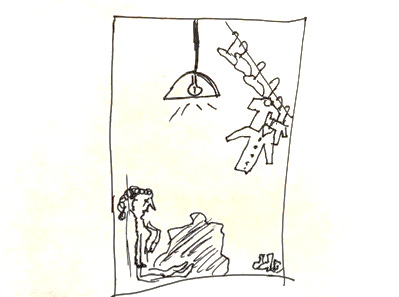
One night around the turn of the millennium I groggily entered my walk-in closet in our bedroom to jab my finger and check my blood sugar. It was the middle of the night. The closet had been designed with a built-in chest of drawers and years earlier, when I ripped the baby blue carpet off the floor, a dark stain was revealed that looked like someone had spilled motor oil and the puddle-looking stain, about the size of a car tire, spread partially beneath the chest of drawers.
On this particular night, as I fumbled for the light switch, there swept through me a feeling of dread—like when you wake up in the morning feeling fine until you remember that your kid is homeless or that your mom has cancer or that your job sucks, etc.—like a stabbing blade of reality puncturing the placid dream-state of unknowing.
As I toggled the light switch On, I intuitively squinted my eyes downward and away from the glaring light bulb above, and in that instant of yellow light exploding away the darkness, I saw the crumpled body of a middle-aged woman sitting on the floor, propped against the chest of drawers, her head slumped onto her chest, a billow of purple-black blood spread beneath her. And then I blinked and she was gone, my heart racing, head swimming with confusion and shock. It wasn’t fear, really, but closer to profound confusion.
I kept blinking and listening to my heartbeat pound in my skull. As a child, I once pulled a turtle out of Otter Creek, where the casino is now. As I lifted it from the muddy water, I was shocked to see someone had carved Fuck You into its shell as clearly as printing on paper. I remember feeling like I was looking at something foreign and from a different dimension of the universe—what kind of person does something like that and why? I remember feeling as if I’d somehow lost some of my own innocence—that I shared a mortal coil with people that tortured animals and what other kind of people are out there and what other evil things were they capable of? I felt as if I’d entered a portal to a separate, uglier, more fascinating reality.
That’s how I felt blinking and staring at the floor of my closet and at the stain there reminding me of what I’d just seen and then seen disappear with a blink. I switched the light on and off several times, seeing if the vision would return but it didn’t, so I eventually shuffled back to bed and stared at the shadows of the ceiling fan spinning. My alarm clock said it was 3:33 a.m. I never said anything to my wife. Looking back, I guess I just didn’t know how.
We’d heard stories of how Doc Hanson’s wife had died in the house or maybe the garage but I’d never really thought about it. I wondered if the woman I’d seen dead and bleeding on my closet floor was somehow connected—perhaps it was her.
Since that night, every time I’d walk into that closet, day or night, I’d cringe a little, wondering if the dead woman on the floor would be there but I never saw her again.
……….
One sunny Saturday afternoon in the summer of 2007, my wife and I sat on our front porch, watching the world go by. Kids the same age I was when I pedaled my then not-yet-wife up the hill traced my tracks on their own bicycles, their own hormones buzzing with electricity and incorrigible, idiotic optimism.
A green Subaru slowly glided-then-parked directly in front of our house and a youngish sixty-something woman emerged from it, waving at us and walking up the sidewalk to our house between the rows of roses and peonies that slowly bobbed and floated in the scented breeze.
As she neared us, my wife said Hello and the woman outstretched her arms as if to embrace the yard, saying,
“Oh, my! I just love what you’ve done with this place!” and a moment later she and my wife were hugging like old friends.
“I grew up in this house,” she said. “I’m Mary Hanson,” and then I stood up, too and hugged her like I knew her.
Inevitably, the tour was on. Inside the house, Mary Hanson could not stop talking and my wife and I couldn’t stop listening. It was fascinating to hear her talk about how there used to be a baby grand piano next to the fireplace and she’d play carols at Christmas. And the night her sister had to be carried up the stairs by her father because she’d been stung by a hornet earlier that day and her foot had swelled so badly she couldn’t walk. Or when she got married, right there in front of the fireplace where we stood. It was moving in a way I hadn’t expected, watching how this woman was being transported back—not just in time—but transported back to the psycho-emotional landscape of childhood, adolescence and young adulthood--the decades she’d lived under that roof, between those walls.
“You wanna see the rest of it?” my wife asked and, of course, Mary Hanson did wanna see the rest of it, so up the stairs we marched to show her the rest of it.
Eventually, we ended up in our bedroom, which seemed a little intrusive to me, but I’m not the boss, so there we were. Then Mary Hanson pointed to my closet door and said,
“Which one of you uses that closet?” and something in my stomach pinched together.
“I do,” I said, looking at her. “The other one is bigger and she’s got ten times more clothes than I do.” It felt a little like I was over explaining and I could feel my wife watching me talk too much like she always does when I always do.
Mary Hanson stared at the closet door.
“Have you guys heard about my mother?” she said with an even, careful tone. My wife and I looked at each other and I said,
“A little. Mostly about your dad, though—Doc Hanson—and people still call this Doc Hanson’s house and we’ve been here for about ten years,” and we all laughed a little but not really.
“My Dad was really something,” Mary Hanson said. “Those were the days when people thought doctors were like God. Everything he did or said was apparently amazing.”
Then she looked at her hands, rubbed them together.
“I loved him because he was my dad but I was also kind of afraid of him because he was a little…much, if anyone looked at it now,” and the conversation stalled as the three of us stood there in our bedroom, staring at the door to my closet.
“You ever notice anything in there?” Mary Hanson asked me and I stood staring, wagging my head No and my wife knew I was lying like she always knew and didn’t say anything like she never did and I just said,
“Not really.”
And Mary Hanson also knew I was lying.
“Well, if you don’t mind me telling you,” she said, “my mom died in that closet.”
……….
She went on to explain that her mother suffered from depression and that, in those days it didn’t often get addressed, that even the wife of a well-respected practicing medical doctor wasn’t immune, and that, at times, she drank too much and that it wasn’t uncommon to come home from school and find her mom slouched in her recliner in front of the tv with an empty highball glass on the end-table along with an uncapped bottle of Mother’s Little Helper next to it.
Then, something seemed to trip in Mary Hanson’s mind and she began speaking quite quickly, her voice dropping nearly to a whisper as if what she was saying was deserving of some sort of secret reverence.
“The day she died,” she began, “my dad had dropped my sister and me off at Washington School, which he typically did on his way to the clinic every morning.”
She went on to explain that her father, Doc Hanson, was a very practical and routinized man, disciplined—sometimes to a fault. She told of how he’d wake up every day at the same time, even on weekends, shaved his face every day at the same time, using the same Gillette razor for years and how, if his routine was ever interrupted, there’d descend on the entire household a sort of heaviness and stress, like a clothesline being pulled tight to the point of snapping.
“My dad made a habit of going home for lunch every day and if he came home and my mom had been drinking, he’d show up at the curb in front of the school to pick us up at the end of the day. Otherwise, we’d walk home. My sister and I came to recognize that if Dad’s car was in front of the school at the end of the day, Mom must be drunk. It was his way of controlling the situation and sort of protecting us from the reality going on at home. On those days, he’d often not bring us directly home. Instead, we’d go to Bridgeman’s or the A&W root beer stand in Sunnyside and give Mom time to get herself together and she’d either make something for dinner or not, in which case, Dad would figure it out and make something or take us to Rudy’s or something.”
Then she told us that, on this particular day, just after she and her classmates had come in from recess after lunch, she and her sister were called to the school office where her father stood waiting for them, saying he was taking them out of school for the rest of the day.
As Doc Hanson ushered his two daughters into the back door of the house I now owned, he crouched to his knees to make direct eye contact with them.
“Your mother died today,” he told them, matter-of-factly. “She died this morning sometime.”
At this point in her telling of the memory, Mary Hanson’s face darkened and she looked directly at the floor, saying,
“He was a very pragmatic man. He wanted to use the occasion as a Teachable Moment. Surely well-intended.”
She then recalled to us how her dad had gently walked them up the stairs and into the bedroom where the three of us now stood. Holding the closet door shut with his hand, he explained to them that he was going to show them their mother, emphasizing that their Mom, was no longer inside the body of their mother and that she was no longer in any pain and that she was joyfully waiting for all of them in heaven beside Jesus and Mary and their heavenly father.
And then he opened the door to reveal Mrs. Hanson, their mother, collapsed on the floor in a thick puddle of coagulating blood.
“The whole closet smelled like iron,” Mary Hanson told us. “I was 9. My sister was 7.”
My wife and I stood thunderstruck as Mary Hanson went on. My heart pounded in my ears like the sound of a pulsing river. Mary Hanson kept talking.
“Looking back, I understood what he was trying to communicate and, like I say, I know he meant for it to be a way of comforting us—letting us know that Mom’s spirit—what made Mom Mom, was no longer there and that the body lying there was just that—her physical body. A vessel. But, Jesus Christ. We were children.”
I couldn’t speak and neither could my wife, her face like a stone, and I felt the familiar feeling of holding back a lie.
“I should go,” Mary Hanson said then, nervously searching her purse for car keys. “I’m sorry—that’s an upsetting thing to have told you. I’m sorry.” Neither my wife nor I could respond and we just nodded, numbly.
“It was lovely to meet you two,” May Hanson said, then, awkwardly, her voice artificially brightening as my wife and I followed her out of our bedroom and down the stairs. “And thank you for letting me take a look around. I love how you clearly love this place.”
And then she left. When she was gone, I told my wife about what I’d seen in that closet all those years ago and she was pissed and I didn’t blame her and we never talked about it again but never didn’t think about it.
……….
In June of 2015 we sold the place to young family with kids and hopes and the kind of optimism I recognized I used to have. Of course, I never mentioned anything about the closet to the new owners because what was I supposed to say, and, anyway, it was just that one time that I saw anything and all of the other horrors that had occurred in that house while we lived there were about equal to the joys and there was nothing supernatural about any of it.
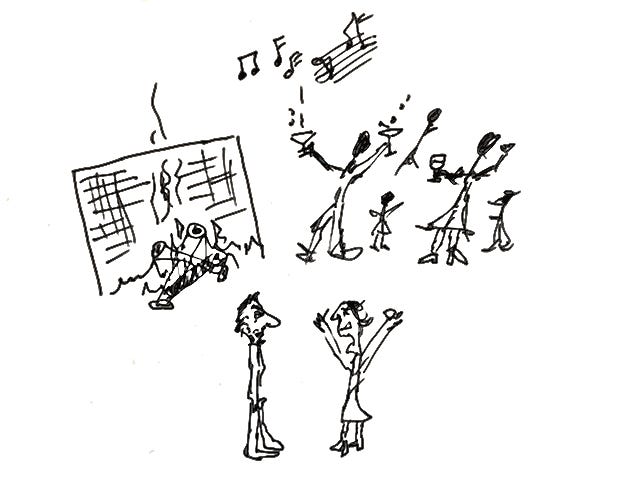
By December we were in our new place. We were invited to a Christmas party in our old neighborhood—an annual tradition we’d shared in all the years we lived in Doc Hanson’s house. Throughout the neighborhood, each year we’d alternate hosting the neighborhood Christmas party and that year it was the turn of our former neighbor across the street. We looked forward to seeing everyone again.
The moment we walked in the door of our former neighbor, I felt lonely for the old place. The smell of warm cider and mulled wine wafted over the heads in the crowded living room, a fire crackling in the fireplace, someone in the kitchen scooping out Tom & Jerry’s. The young woman that had bought our house was there and she found my eyes with hers, which were slightly glossy, she having been there a while. I nudged my wife, saying,
“There’s Lisa, who bought our place,” and my wife smiled dimly, saying,
“I miss it,” and I thought of her behind me on the seat of my ten-speed all those years ago and my heart drifted downward like a skipping stone losing momentum.
Then Lisa was greeting us warmly and re-introducing us to her friendly husband, both of them gushing about how they loved the place and how perfect it was for their kids and how great the neighborhood was and if there’s such thing as Seller’s Remorse, my wife and I were feeling it.
My wife deftly found a way to disengage, saying something about being parched, heading toward the kitchen and the Tom & Jerry’s and I was left standing with Lisa, her husband having also moved on, having run out of things to talk about once all of the fawning about the house and neighborhood had ebbed.
“How do you guys like your new place,” Lisa asked me.
“Oh, it’s great,” I said back. “A lot of work ahead of us, though,” and Lisa nodded, lifting her champagne glass to her lips. Then she said,
“Did you ever notice anything weird happen in the house?” and I think my face must have done something or maybe it just seemed to me that it did, the way her eyes searched mine for signs of lying.
“Weird?” I said back, buying time the way politicians do when trying to answer a question without answering. “Whaddaya mean by weird?”
Her eyes stayed stabbed into mine, “I dunno,” she said, sipping her champagne. “Just anything?” And then she softly grabbed my elbow and turned me a little so that the two of us—at least our voices—were a bit secluded from the rest of the hub-bub in the teeming room of Christmas revelers.
She took a deep breath then and drained her champagne glass and looked at the floor and then back up at my face as if restarting the conversation.
“Jim was deer hunting a few weeks back and it was the first time I’d slept in the house alone—I mean the kids were there, but I mean without Jim, since he was at the hunting shack.”
I think I must have nodded because after watching my face for a second, she went on.
“I dunno,” she stammered a little as if reconsidering what to say or if to say. “It was just the weirdest thing,” and she paused again and then just blitzed through it.
“I went to bed the same time I always do. I read for a while, like I always do, then turned off the light and fell asleep quickly like I usually do.” I must have nodded for her to go on because she did.
“And then I woke up in the middle of the night, freezing—and I’m never cold when I sleep, in fact, I sleep hot and so that was one weird thing, when I look back, but anyway, so I got up and checked the radiator and it was working and ticking away, so it wasn’t that, so then I went to grab some warmer pajamas out of my closet and when I opened the door and turned on the light, I –” and she stopped herself and, again, caught my eyes watching hers and we just stared at each other for a long moment before she started again saying what she was saying.
“…Anyway, when I flicked on the light, in the nano-second between it being dark and having the light bulb turn on, I swear, I saw a woman’s body bent over on the floor in a puddle of blood and…” then she saw me knowing what I knew and she said,
“Did you ever experience anything weird like that?”
Now, I am not proud to say this, but it is true: I’m a pretty damn good liar. But that was the instant—in all my years of expert lying—that I realized I wasn’t a Hall-of-Famer in the craft. I stood there, dumbstruck like a mannequin. Hearing her talk about it somehow made it more real than it had been, as if I’d managed to subconsciously convince myself over the years that the event never really took place that night when I went into that closet to test my blood and saw Doc Hanson’s wife lying there as real as dead flesh and blood. And now Lisa had confirmed something unconfirmable.
“…I’m not sure,” I managed and she was unconvinced.
“You’re fucking lying,” Lisa said, a broad, satisfied smile spreading over her flushing face. “Thank God, I’ve not gone psycho.”
And I said, “Thank God, me too, neither.”
……….
The conversation fizzled after that. There was a mutually dawning understanding that there was nothing much else to say about it and certainly nothing to do, since Ghost Busters ain’t real, and honestly, other than the confusion and shock of the experience, and the wary way it made me feel—albeit a wariness that dimmed over time—it really had been a sort of No Harm, No Foul situation, and instead of a dead lady in a puddle of blood, if it had been a vision of Mary Magdalene or a bleeding Jesus of Nazareth, I’d probably be considered for sainthood or at least not scary or haunted, which made me consider the distinction between experiencing the Holy Ghost and any other ghost not credited with holiness.
Thankfully, our respective spouses interrupted the awkward conversational terminus and dragged us away toward the rest of the night, which somehow ended with us back home in our new place and me lying in bed, hands clasped behind my head, staring at the ceiling. In those last moments of night before the eastern edge of sky cracked to lead gray, it occurred to me that the distinction between this earthly life and the existence we’ve all imagined being available to us afterward, via some other level of consciousness, or lack thereof, ie: Heaven, Hell, Purgatory, Sixth Sense-stuff, is only mysterious due to the lack of understanding of the thin veil separating this arena of understanding from other arenas that are less understandable, but every bit as real, the same way microbiology was once beyond our understanding but real, regardless—a reminder that of all the wondrous progress given to us via the Enlightenment, one of its curses has been the pious arrogance that asserts if we can’t understand or prove something, then it doesn’t exist. Or isn’t real. Or doesn’t matter.
But there I was, lying next to my wife in our new place, having it matter, like anyone else wondering about where heaven lives and the thin veil that separates it from hell, neither mattering much at all since no one can explain or prove it.
And just as dawn was dawning, I closed my eyes and thought of what goes on inside that closet over on Chestnut Street in Doc Hanson’s house when no one is opening that closet door.
-parnell
April 2026
You are an exceptional writer Par!
Great story! Again! Keep it up! Thanks for telling the hometown stories!